
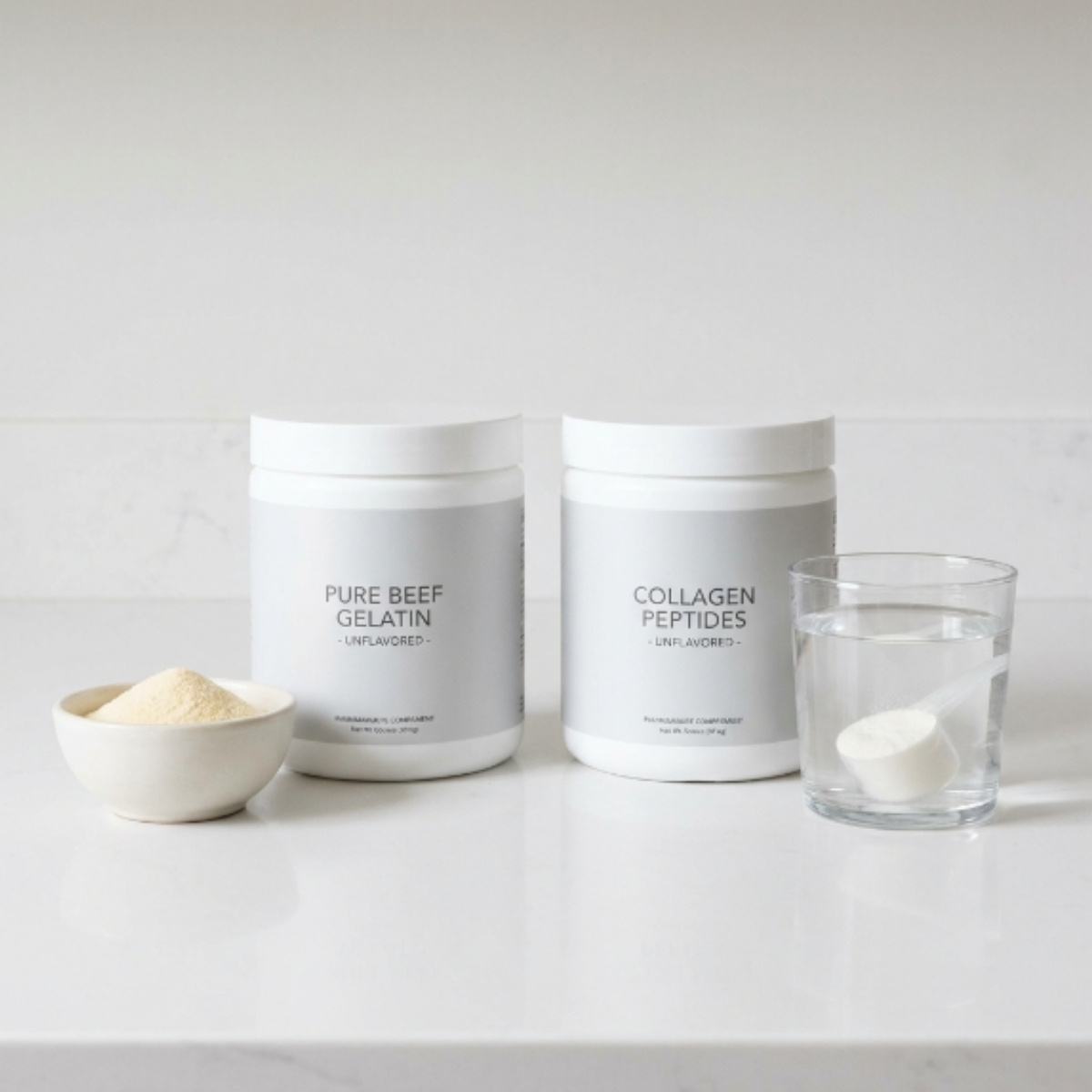
Beef gelatin and collagen peptides sit next to each other on the same supplement shelf, often with similar packaging and almost identical ingredient labels. Both say grass-fed bovine. Both list glycine and proline. Both promise benefits for skin, joints, and gut health. So what exactly is the difference, and does it actually matter which one you buy?
The short answer is yes, it matters, but not for the reason most people assume. The difference is not about which is healthier. It is about what each product physically does in a recipe and in your body, and understanding that distinction will tell you immediately which one you need for any given purpose.
This article explains the difference clearly, covers when to use each one, answers whether you can substitute one for the other, and gives a direct verdict on which is the better choice depending on your specific goal. For a deeper background on beef gelatin specifically, see our complete beef gelatin guide.
Jump to:
- Where They Both Come From
- The Key Differences: A Quick Summary
- What Is Beef Gelatin?
- What Are Collagen Peptides?
- Does Beef Gelatin Have Collagen in It?
- Which Is Better for Gut Health?
- Which Is Better for Skin and Hair?
- Which Is Better for Joint Health?
- Can You Substitute Beef Gelatin for Collagen Peptides in Recipes?
- Beef Gelatin vs Agar Agar
- Price: Which Is Better Value?
- Our Verdict: When to Use Which
- Frequently Asked Questions
- The Bottom Line
Where They Both Come From
Both beef gelatin and collagen peptides start from the same raw material: collagen extracted from cattle hides, bones, and connective tissue. Collagen is the most abundant protein in mammals and forms the structural framework of skin, cartilage, tendons, ligaments, and bone. The two products are simply the same source material processed to different degrees.
Think of it this way. A strong rope is the original collagen structure. Unravel those threads and you get gelatin, where the long molecular chains are partially broken but still long enough to interlock and form a gel. Unravel those threads even further into the smallest possible fragments and you get collagen peptides, also called hydrolyzed collagen, where the chains are broken down so completely that they dissolve in any liquid and never gel.
This difference in molecular size is the single most important thing to understand about these two products. Everything else follows from it.
The Key Differences: A Quick Summary
| Beef Gelatin | Collagen Peptides | |
|---|---|---|
| Source | Bovine collagen | Bovine collagen |
| Processing level | Partial hydrolysis | Full hydrolysis |
| Molecular size | Larger chains | Small peptide fragments |
| Dissolves in cold liquid | No | Yes |
| Dissolves in hot liquid | Yes | Yes |
| Gels when cooled | Yes | No |
| Amino acid profile | Glycine, proline, hydroxyproline | Glycine, proline, hydroxyproline |
| Absorption speed | Moderate | Faster |
| Best for cooking | Yes, gummies, marshmallows, jello | Not suited for gelling recipes |
| Best for drinks | Hot drinks only | Any drink, hot or cold |
| Typical price per gram | Lower | Higher |
What Is Beef Gelatin?
Beef gelatin is bovine collagen that has been partially broken down through a controlled heating and acid process. The result is a fine powder that, when dissolved in hot liquid and allowed to cool, forms a firm gel. This gelling property is its defining characteristic and the reason it is irreplaceable in certain recipes.
When you make gummies, marshmallows, panna cotta, homemade jello, or any recipe that needs to hold a set shape, beef gelatin is the ingredient doing that work. Collagen peptides cannot do this. No amount of collagen peptides will set a gummy or hold a marshmallow together, because their molecular chains are too short to form the gel network that gelatin creates.
Beef gelatin must be bloomed first in cold liquid before being dissolved in hot liquid. It only dissolves properly in warm or hot liquid and will clump if you try to add it directly to cold drinks. Once set, it softens and melts again at around 35 degrees Celsius, which means gelatin-set recipes need to be kept cool.
What Are Collagen Peptides?
Collagen peptides, also called hydrolyzed collagen or collagen protein powder, are bovine collagen that has been broken down much further using enzymes in addition to heat. The resulting fragments are so small that they dissolve completely in any liquid, hot or cold, without any blooming step and without any gelling effect.
This makes collagen peptides significantly more convenient for supplementation. You can stir a scoop into cold water, a smoothie, orange juice, or your morning coffee without changing the texture or appearance of the drink in any noticeable way. This invisibility is the main reason collagen peptides dominate the supplement market despite costing more per gram than beef gelatin.
Collagen peptides are also absorbed slightly faster than gelatin because their smaller molecular size means the body processes them more quickly. The practical difference in outcomes between the two is modest for most purposes, but for someone taking collagen specifically around exercise for joint recovery, the faster absorption of peptides has a slight edge.
Does Beef Gelatin Have Collagen in It?
Beef gelatin does not contain collagen in its intact original form. It is made from collagen and contains all the same amino acids that collagen is composed of, but the manufacturing process converts the collagen structure into gelatin. Gelatin is denatured collagen, not raw collagen.
What this means practically is that beef gelatin supports your body’s own collagen production by supplying the amino acid building blocks it needs, specifically glycine, proline, and hydroxyproline. This is the same mechanism by which collagen peptides work. Neither product puts intact collagen directly into your tissues. Both supply the raw materials your body uses to synthesise its own collagen.
So yes, beef gelatin supports collagen production. No, it is not the same molecule as the collagen in a collagen peptides supplement. In terms of the end result for your joints, skin, and gut, the two are closely comparable when taken consistently over time.
Which Is Better for Gut Health?
Both support gut health through the same mechanism: their glycine content supports the integrity and repair of the gut lining. The amino acid profile of beef gelatin and collagen peptides is essentially identical for this purpose.
There is one additional argument for beef gelatin specifically when it comes to digestion. Because gelatin absorbs water and forms a gel-like substance in the digestive tract, it may provide a more direct soothing effect on the gut lining as it passes through. Some practitioners working with leaky gut or inflammatory bowel conditions prefer gelatin over peptides for this reason, though the research directly comparing the two for gut outcomes is limited.
For general daily gut support, either works. For someone specifically trying to address gut lining repair, a slight case can be made for gelatin over peptides, but the consistency of daily intake matters far more than which form you choose.
Which Is Better for Skin and Hair?
The research on collagen and skin health has primarily used collagen peptides rather than gelatin, simply because peptides are the form that has attracted more supplement industry funding for clinical trials. Studies on collagen peptides have shown improvements in skin elasticity and hydration after 8 to 12 weeks of consistent daily use.
Beef gelatin provides the same amino acids and supports the same collagen synthesis pathways. The practical outcomes for skin and hair are closely comparable. If you are already using beef gelatin regularly in recipes or as a daily supplement in hot drinks, you are getting the same fundamental benefit as someone paying more per gram for collagen peptides in a cold smoothie.
The advantage of peptides for skin is purely the convenience of taking a consistent daily dose invisibly in any drink. If convenience is your main concern and you do not care about the cooking applications, peptides are worth the small price premium. If you already cook with gelatin regularly, the skin benefit arrives without any extra effort or cost.
Which Is Better for Joint Health?
Again, both provide the same amino acids that support cartilage and connective tissue repair. The research most commonly cited for joint recovery, including the work of Dr Keith Baar at UC Davis, used gelatin specifically rather than peptides, with the protocol involving 15 grams of gelatin taken alongside vitamin C 30 to 60 minutes before exercise.
For the pre-exercise joint protocol specifically, beef gelatin has the stronger direct research backing. For general daily joint supplementation, both are effective and the difference in outcomes is likely negligible. The most important factor for joints is consistency over time rather than which form of bovine collagen you use.
Can You Substitute Beef Gelatin for Collagen Peptides in Recipes?
It depends entirely on what the recipe is doing with the ingredient.
If a recipe calls for collagen peptides to be stirred invisibly into a smoothie, coffee, or cold drink, you cannot substitute beef gelatin without changing the result significantly. Beef gelatin will not dissolve in cold liquid. In a hot drink it will dissolve, but if the drink cools it may begin to thicken or even partially gel.
If a recipe calls for gelatin to set a gummy, marshmallow, jello, or any other gel-based preparation, you absolutely cannot substitute collagen peptides. The recipe will not set. Collagen peptides have no gelling ability regardless of the quantity used.
Where substitution works is in hot soups, stews, and sauces where the recipe uses gelatin purely as a nutritional addition rather than for its gelling effect. In that case, collagen peptides can be stirred in without any issue. One tablespoon of beef gelatin is roughly equivalent as a nutritional substitute to one tablespoon of collagen peptides, though the gelatin will add slightly more body to a sauce or broth as it cools.
Beef Gelatin vs Agar Agar
Agar agar is a plant-based gelling agent derived from seaweed. It is 100 percent vegan, halal by default, and kosher. It gels at a higher temperature than beef gelatin and sets firmer, which means it holds its shape at room temperature where beef gelatin would soften and eventually melt.
Agar agar can substitute for beef gelatin in gelling recipes, but the ratio is different and the texture is notably different. Agar sets brittle and firm rather than soft and wobbly. It is also less forgiving: overheated or cooled too quickly it can set grainy rather than smooth. For most gummy and marshmallow recipes, agar agar produces an inferior result compared to beef gelatin in terms of texture and mouthfeel.
Agar agar also provides none of the amino acid benefits of beef gelatin. It is a polysaccharide, not a protein, so it has no glycine, no proline, and no collagen-supporting properties. It is a functional gelling agent, not a nutritional supplement.
For vegan households that need a gelling agent, agar agar is the correct choice. For halal households that want both gelling function and nutritional benefit, beef gelatin with halal certification is the better option. Our is beef gelatin halal guide covers which brands are certified.
Price: Which Is Better Value?
Beef gelatin is consistently cheaper per gram of protein than collagen peptides. Real-world pricing on Amazon puts NOW Foods beef gelatin at roughly 75 cents per ounce, while comparable collagen peptide products typically run from $1.10 to $1.50 per ounce. For someone taking 15 to 20 grams per day as a consistent supplement habit, that difference adds up to a meaningful saving over a year.
The premium for collagen peptides is essentially a convenience premium. You are paying more for the ability to dissolve it in cold liquid without any preparation step. If you are making hot drinks or cooking with it anyway, you are paying for a feature you do not need. For a full breakdown of the best value beef gelatin brands, see our best beef gelatin powder buyer’s guide.
Our Verdict: When to Use Which
Use beef gelatin when you need it to gel: gummies, marshmallows, jello, panna cotta, aspic, and any recipe where the structure depends on the protein setting firm. Also use it when price matters and you are happy to dissolve it in a hot drink or add it to hot food. For the pre-exercise joint recovery protocol, beef gelatin is the form with the most direct research support.
Use collagen peptides when you want to add collagen protein invisibly to cold drinks, smoothies, or any recipe where gelling would be a problem. If your primary use case is a morning cold brew or a post-workout shake, peptides are worth the price premium for the convenience.
Use both if your routine involves cooking and daily supplementation. Many people keep beef gelatin in the kitchen for recipes and a collagen peptide tub on the counter for cold drinks. There is no conflict between the two and no reason to choose only one if both fit naturally into your routine.
For more on the full range of benefits that apply to both, see our beef gelatin benefits guide, which covers the research in detail. And if you are ready to start cooking with beef gelatin, our gummies recipe and marshmallows recipe are both straightforward starting points.
Frequently Asked Questions
Is beef gelatin the same as collagen?
No. Both come from bovine collagen but are processed differently. Beef gelatin is partially hydrolyzed and gels when cooled. Collagen peptides are fully hydrolyzed and dissolve in any liquid without gelling. They have the same amino acid profile and comparable health benefits.
Can I use beef gelatin instead of collagen powder?
In hot food and drinks, yes, with the understanding that it may thicken slightly as it cools. In cold drinks or smoothies, no. In gelling recipes, beef gelatin is required and collagen powder cannot substitute.
Which has more protein: beef gelatin or collagen peptides?
They are comparable. Both provide roughly 9 grams of protein per 10 gram serving with zero fat and zero carbohydrates. The amino acid profile is essentially identical across both products from bovine sources.
Is collagen better than gelatin for skin?
Most skin research has been conducted using collagen peptides, so that form has more direct clinical backing. However, beef gelatin provides the same amino acids through the same mechanism. For consistent daily supplementation, the outcomes for skin are very similar. Peptides have a convenience advantage for cold drink users.
Does beef gelatin have the same benefits as collagen supplements?
Yes, closely. Both provide glycine, proline, and hydroxyproline to support collagen synthesis in the body. The benefits for skin, joints, gut health, and sleep are comparable. The main practical differences are in solubility, gelling behaviour, and price rather than in health outcomes.
Which is cheaper: beef gelatin or collagen?
Beef gelatin is consistently cheaper, typically by 30 to 50 percent per gram of protein. If budget matters and you are comfortable dissolving it in a hot drink or cooking with it, beef gelatin delivers comparable benefits at lower cost.
The Bottom Line
Beef gelatin and collagen peptides are the same source material processed to different degrees. They share the same amino acids, support the same health benefits, and come from the same grass-fed cattle. The difference is purely functional: beef gelatin gels and must be used in hot applications, while collagen peptides dissolve invisibly in anything. Choose based on what you need the ingredient to do, not on which is healthier, because for most practical purposes that distinction does not exist.
If gummies, marshmallows, or any set recipe is on your agenda, beef gelatin is the only option that works. Start with our beef gelatin gummies recipe or marshmallows recipe to see exactly what it does in practice.

Leave a Reply